
Benefits of Advanced Screw Press Technology for Oilseeds
Benefits of Advanced Screw Press Technology for Oilseeds
When producers compare cold press oil machines, they often look first at motor power, hourly capacity or machine size. These are important, but the pressing technology itself is just as important because it directly affects how the raw material is compressed and how consistently the process can be managed.
Two machines may look similar from the outside and still behave differently during production. The reason is often found inside the press: screw geometry, compression profile, outlet resistance and how the machine handles the raw material as it moves forward.
This is why mechanical screw press technology has become a practical choice for many producers working with black seed, sesame, sunflower, flaxseed, pumpkin seed, safflower, hemp, grape seed, coconut, castor and many other oil-bearing materials.
What Is the Main Goal of Oilseed Pressing?
The basic goal is simple: separate as much oil as practical from the raw material while keeping the process stable, repeatable and suitable for continuous production.
In practice, this depends on more than one thing. The seed must be prepared correctly. Moisture should be suitable. The nozzle should match the material. Motor speed should be adjusted. And the press should create enough resistance to separate oil without making the process unstable.
The Machine and the Raw Material Work Together
A well-designed press cannot completely compensate for poorly prepared seeds. At the same time, correctly prepared raw material performs better when the pressing system applies controlled and consistent compression.
How Does a Mechanical Screw Press Work?
In a mechanical screw press, the raw material enters through the hopper and is carried forward by a rotating screw. As the material moves through the pressing section, available space is reduced and compression gradually increases.
Oil separates through the openings in the press section while the remaining compressed material continues toward the cake outlet. The oil and press cake leave the machine through different paths.
Once the machine is correctly adjusted, this process can continue without the stop-and-start cycle used in batch pressing systems.
Why Does Screw Design Matter?
Not every screw is the same. The screw is not only responsible for moving seeds forward. Its geometry also influences how pressure builds inside the machine.
If the raw material moves too quickly, there may not be enough compression. If resistance becomes excessive, the machine can become difficult to operate. The goal is controlled compression: enough pressure to separate oil while maintaining a stable flow of press cake.
This balance is one of the most important parts of screw press design and one of the reasons machine settings should be adapted to the raw material being processed.
Can Screw Press Technology Improve Oil Yield?
Oil yield is never determined by the machine alone. Seed variety, moisture, storage, preparation method, natural oil content and operator settings all influence the final result.
However, when suitable raw material is used and the machine is correctly adjusted, a mechanical screw press can provide stable and efficient oil separation.
For this reason, we always recommend evaluating pressing performance together with the condition of the raw material rather than looking only at the motor size or the machine itself.
Continuous Production Is a Major Advantage
One of the main advantages of screw press technology is the ability to work continuously. After the machine reaches a stable operating condition, prepared raw material can be fed regularly and pressing can continue without opening and reloading a separate pressure chamber for every batch.
This makes production easier to plan. It also allows the operator to observe oil flow, cake discharge and machine load while making small adjustments when necessary.
New operators should still monitor the process closely until they understand how the machine reacts to different seeds. Once the correct settings are known, regular production becomes much easier.
How Is It Different from Hydraulic Pressing?
Hydraulic presses have been used in oil extraction for many years and remain suitable for some production methods. Mechanical screw presses offer a different approach.
Screw presses are available in compact single-head models as well as larger industrial systems. This makes the technology easier to scale according to the producer's required capacity.
- Continuous rather than batch-only operation
- Compact models for smaller producers
- Industrial models for higher production capacities
- Relatively simple mechanical operation
- Easier integration into continuous oil-processing lines
- Practical adjustment through motor speed and outlet resistance
One Technology, Different Production Scales
Another advantage is that the same basic pressing principle can be used at very different scales. A small producer may begin with a compact single-head machine, while an industrial producer may use larger motors or several press heads working together.
This makes mechanical screw pressing useful for laboratories, farms, boutique oil producers, commercial workshops and industrial facilities.
The right machine is not necessarily the biggest one. It is the model that matches the raw material, daily production target and available electrical infrastructure.
The Press Cake Is Part of the Process Too
Producers naturally focus on the oil, but the material leaving the cake outlet should also be observed. Its structure gives useful information about how the press is operating.
Depending on the seed and the intended process, press cake may also have value in another application. The important point is that efficient production should consider the complete raw material, not only the oil leaving the press.
Why Stable Operation Matters
A production system is easier to manage when it behaves consistently. Stable oil flow, regular cake discharge and predictable machine load make the process easier for the operator.
Once a suitable combination of raw-material preparation, motor speed and nozzle size is found, the same method can be repeated for future batches of similar material.
This is especially important for businesses that produce oil regularly rather than only occasionally.
A Practical Option for Small and Medium Producers
In the past, professional oil production was often associated mainly with larger processing plants. Today, compact mechanical screw presses make it possible for smaller producers to process their own raw material and control production directly in their own workshop.
For many businesses, that control is as important as the machine capacity itself. They can test different seeds, develop their own production routine and scale the system as demand grows.
Conclusion
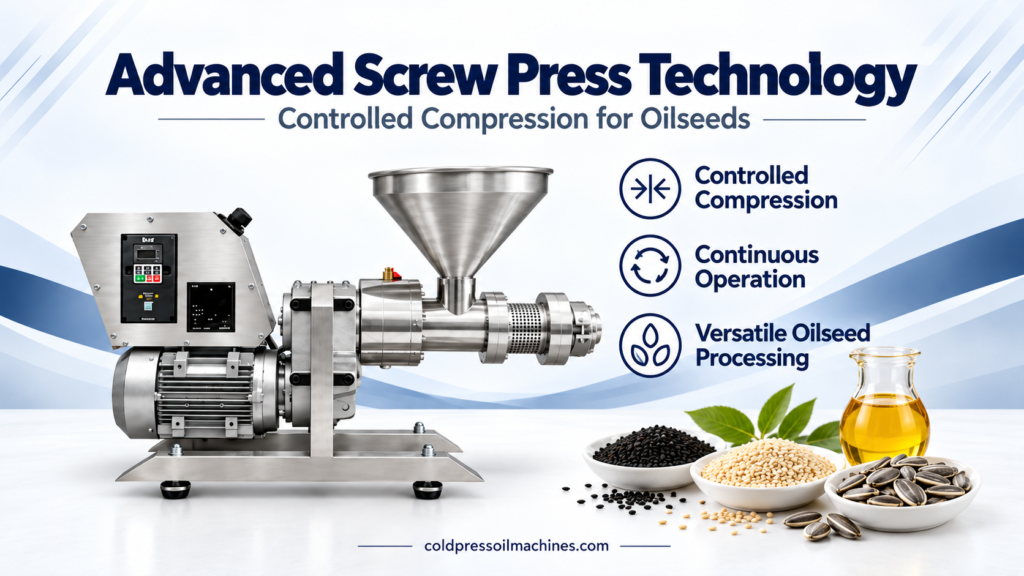
Advanced screw press technology is not only about a larger motor or a different machine body. The real value is in controlled compression, continuous operation and the ability to adapt the process to different oil-bearing raw materials.
In our experience, the best results come when three things work together: properly prepared seeds, a suitable screw press and correct operating settings.
When these conditions are in place, mechanical screw pressing becomes a practical, scalable and efficient way to produce cold-pressed oils.
Looking for the Right Screw Press for Your Oilseeds?
Tell us which raw material you plan to process and your required hourly or daily capacity. We can help you compare suitable single-head machines and industrial cold press oil lines.
View Oil Press Machines View Industrial Oil Lines Contact Us WhatsAppadvanced screw press technology cold pressing continuous oil production mechanical screw press oil extraction oilseeds
