
Cold Pressed Oil Quality: Why Extraction Temperature Matters
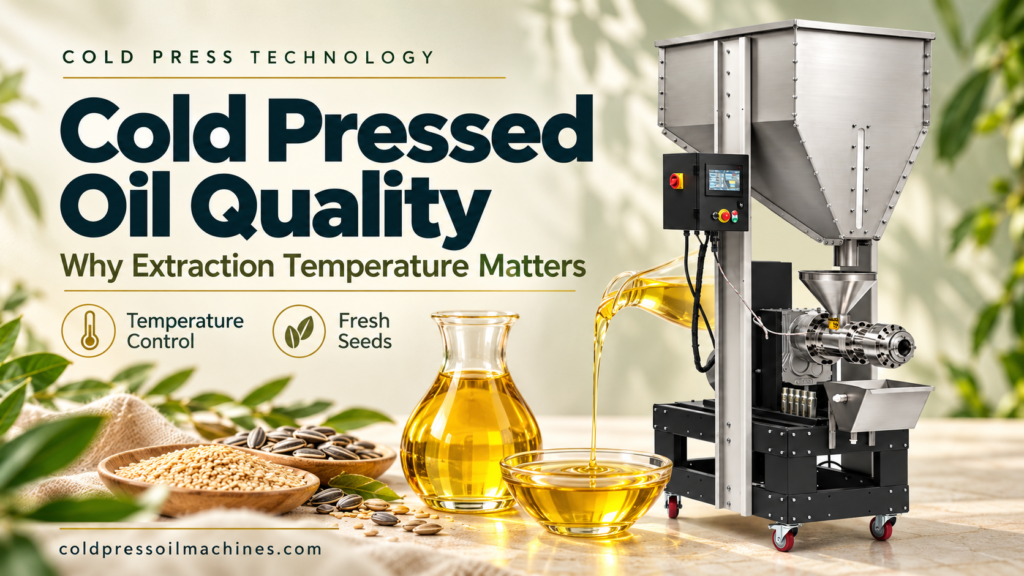
Good Oil Starts With Careful Extraction
Open a bottle of well-made sesame oil and its character is immediately noticeable. The aroma, flavor and color tell you something about the seed it came from. Preserving that character is one of the reasons producers choose a cold press oil machine.
Cold pressing offers a mechanical route from oilseed to finished oil, without using extraction solvents. When the raw material is fresh and the process is managed carefully, it can produce oils valued for their distinctive taste and naturally occurring compounds.
But what makes cold pressed oil quality different? Temperature plays a part, although the complete answer begins before the seed enters the machine and continues after the oil leaves it.
What Is Cold Pressed Oil?
A screw press compresses oil-bearing material and separates the expressed oil from the solid press cake. The collected oil can then be settled or filtered, depending on the intended product.
Codex describes cold pressed oils as oils obtained by mechanical procedures without the application of heat. It allows physical purification methods such as settling, filtering and centrifuging. This definition does not establish one numerical extraction-temperature limit for every seed oil. [1]
Mechanical pressing still creates friction. A producer therefore needs to understand the actual thermal conditions of the process, rather than rely on the machine name alone.
Why Does Extraction Temperature Matter?
The reason for controlling temperature is straightforward: producers want to extract the oil while limiting unnecessary thermal exposure. That objective matters when the product is being sold for its natural aroma, flavor and composition.
In a study comparing sesame oils pressed at different temperatures, increasing the pressing temperature reduced the measured tocopherol content. Tocopherols include forms of vitamin E. The findings show why extraction conditions deserve attention, while also reminding us that results belong to the particular seeds and process studied. [2]
There is no single temperature at which every valuable compound suddenly disappears. Different compounds respond differently, and the time spent at a temperature also matters. A careful producer controls the process and checks the finished oil rather than promising that every nutrient is preserved completely.
At What Temperature Is Cold Pressed Oil Produced?
Published measurements show that relatively cool oil can be collected during screw pressing. For example, a black cumin oil study reported an oil temperature of 21.2°C at one first-stage pressing condition, while the press cake reached 46.6°C. Those figures describe a specific experiment and are not a universal operating range. [3]
This difference is useful: the oil, cake and metal parts do not necessarily have the same temperature. A reading taken from the press head cannot be substituted for a measurement of the flowing oil.
A target such as keeping outlet oil below 40°C or 50°C can be part of an individual production specification. It should not be presented as a worldwide definition of cold pressing or as proof of quality on its own. The seed type, complete process and applicable labeling requirements must also be considered.
Press-Head Temperature and Oil Temperature Are Different
Some screw presses use a heater around the press-head or cake-outlet area to assist startup and material flow. The heater display indicates a machine setting or local sensor reading; it does not tell the operator the temperature of all the expressed oil.
However, a low outlet reading alone cannot establish that a process using applied heat meets a cold-pressed labeling definition. Producers should document heater use, raw-material treatment and actual product temperatures when describing their oil.
For production control, the practical question is how the whole system behaves with your particular seed. Watch the oil temperature alongside throughput, cake discharge and machine load.
The Natural Character of Cold Pressed Seed Oils
For many specialty oil businesses, the appeal lies in a product with recognizable seed character. A mild sunflower oil, a distinctive black seed oil and a delicate flaxseed oil serve different customers and uses. Their quality should be assessed against what each oil is supposed to be.
Research on several cold-pressed oils measured antioxidant activity and showed that oxidative stability varied between oils. Antioxidant activity alone did not reliably explain all of their storage behavior. This supports an important production principle: natural compounds are valuable, but they do not remove the need for careful handling and testing. [4]
A quality-focused brand can explain its seed origin, production method and batch checks clearly. These details give customers something more useful than a broad claim that every cold pressed oil is automatically superior.
Fresh Seeds Are Essential to High-Quality Oil
A press cannot reverse poor storage or make deteriorated seeds fresh again. Start with suitable food-grade raw material, check supplier consistency and inspect each batch before production.
Seed cleaning, appropriate moisture control and protection during storage belong in the same quality plan as machine operation. Reject unsuitable material rather than trying to compensate with tighter settings or a different speed.
For the operator, consistency is especially helpful. Recording the supplier, seed batch, preparation and press settings makes successful production easier to repeat.
Balance Oil Yield With Product Quality
The highest extraction yield is not the only useful measure of a production run. If a setting improves yield but makes operation unstable or pushes oil temperature beyond your specification, it needs to be reviewed.
Adjust speed and outlet resistance according to the machine instructions and raw material. Change one variable at a time, allow the process to stabilize, and record the result. This creates a practical basis for comparing production conditions.
Choose a seed oil press machine around the material you intend to process, your required daily output and the product standard you want to achieve.
Protect Quality After the Oil Leaves the Press
Collection, settling, filtration and bottling are part of the production process. Keep collection vessels clean, use suitable food-contact equipment and prevent old residues from carrying over into a new batch.
Limit unnecessary exposure to air, light and heat during handling and storage. Research on cold-pressed oils identifies these exposures as relevant to deterioration during storage. [4]
Use packaging and storage instructions appropriate to the oil. Establish shelf life through product-specific assessment rather than copying a date from another seed oil.
How Can Producers Demonstrate Oil Quality?
Temperature records are useful evidence of process control. Finished-product checks provide a fuller picture.
Depending on the oil and its intended market, a quality program may include sensory assessment, acid value, peroxide value and additional oxidation tests. The research cited here used acid, peroxide and p-anisidine values to examine different aspects of oil condition. [4]
Work with a suitable laboratory to select tests and acceptance criteria for your product. Clear batch records help connect a laboratory result to the seeds, settings and handling conditions that produced it.
Frequently Asked Questions
Does cold pressing preserve all vitamins and antioxidants?
No process should be described as preserving every compound completely. Retention depends on the seed, processing conditions and subsequent handling. Laboratory analysis is needed to support specific composition claims.
Is oil produced below 50°C automatically high quality?
No. A low measured temperature is one useful process indicator. Fresh raw material, hygiene, sensory quality, oxidation condition and storage still matter.
Does a heater display show the oil temperature?
No. Measure the expressed oil separately. A heater or press-head reading describes a different location in the machine.
Can filtered oil still be cold pressed?
Yes. Codex includes filtration among the permitted physical purification methods for cold pressed oils. Filtration itself does not turn oil into a refined product. [1]
Build Quality Into Every Production Batch
Cold press technology gives producers a practical way to make distinctive seed oils through mechanical extraction. Its value is strongest when careful temperature control is combined with fresh seeds, reliable operation and thoughtful handling.
For a business building a premium oil range, quality is a daily practice: choose the raw material carefully, measure the process, keep equipment clean and verify what goes into the bottle.
Planning Your Cold Press Oil Production?
Tell Ekiciler Makina which seeds you want to process and your daily production target. We can help you review suitable machine options and the operating conditions to discuss before you start.
Explore Oil Press Machines Contact Our TeamSources and Further Reading
- FAO / Codex Alimentarius — Vegetable oils and fats: definitions of virgin and cold pressed oils.
- The Effect of Extraction by Pressing at Different Temperatures on Sesame Oil Quality Characteristics. Foods (2024).
- Antioxidant Potential Evaluation at Various Stages of Black Cumin Oil Production (2024).
- Prescha et al. — The Antioxidant Activity and Oxidative Stability of Cold-Pressed Oils. Journal of the American Oil Chemists' Society (2014).
cold pressed oil quality cold pressing extraction temperature oil quality oilseed processing screw press
