
How to Choose an Industrial Cold Press Oil Line
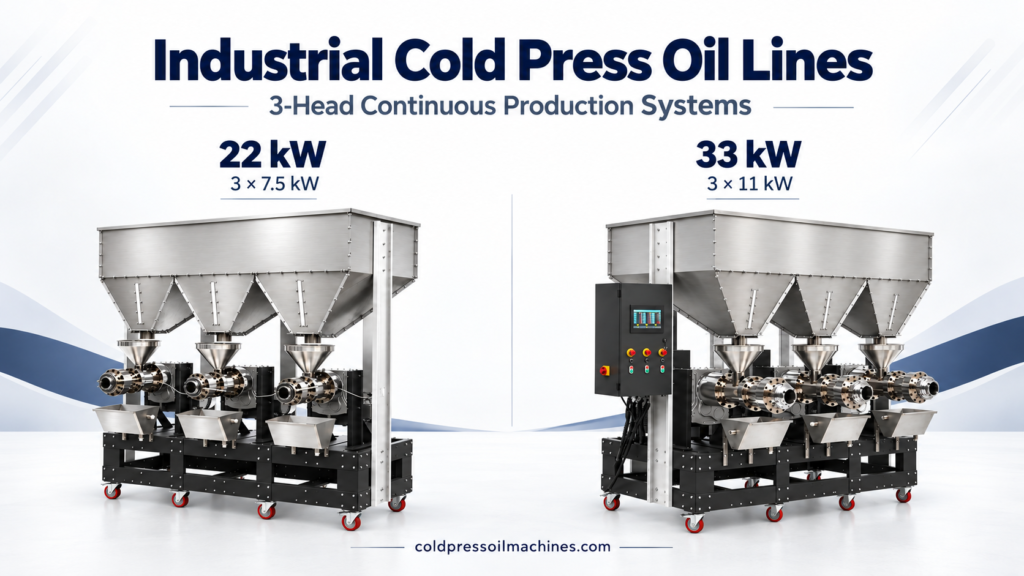
Choosing an Industrial Cold Press Oil Line
When production grows beyond the capacity of a single press, the machine itself is no longer the only question. Seed feeding, continuous operation, electrical supply, oil collection and production planning all become more important. This is where multi-head cold press oil lines start to make sense.
A producer processing a few hundred kilograms per day has very different needs from a business planning continuous industrial production. As capacity increases, the whole process needs to be reviewed, not just the size of the press.
This guide focuses on our two current 3-head industrial cold press oil lines: the 22 kW system and the 33 kW system. Both use three synchronized mechanical screw presses, but the motor power and total production capacity are different.
Important
This article covers only the 3-head systems. Four-head and five-head configurations will be explained separately because they require a different capacity and production-planning discussion.
Why Multi-Head Oil Lines?
At industrial scale, continuous production becomes more important. Every unnecessary stop affects output, labor planning and the overall production schedule.
A multi-head system allows several pressing units to work at the same time. Prepared raw material is distributed to the press heads, oil is collected through the integrated system, and the line can continue operating as long as raw material is supplied and the production conditions remain stable.
The goal is not simply to place several machines next to each other. A proper oil line combines pressing, seed flow, oil flow, heating and digital control into one coordinated production system.
22 kW and 33 kW Lines at a Glance
| Model | Press Heads | Motor Configuration | Typical / Maximum Capacity |
|---|---|---|---|
| 22 kW Cold Press Oil Line | 3 Heads | 3 × 7.5 kW | Approx. 60–150 kg/h, max. 150 kg/h |
| 33 kW Cold Press Oil Line | 3 Heads | 3 × 11 kW | Approx. 240–330 kg/h, max. 330 kg/h |
These figures are approximate operating values. The actual capacity always depends on the raw material, moisture level, hardness, particle size, oil content and preparation method.
22 kW Cold Press Oil Line – 3-Head Industrial System
The 22 kW line is designed for industrial producers who have outgrown single-head production but do not yet require the higher output of the 33 kW system.
It combines three interconnected pressing units with automated seed feeding, oil flow, heating and digital machine control.
Capacity changes significantly depending on the raw material. For example, small and soft seeds such as sesame may process differently from black seed or sunflower seed.
This model is suitable for businesses that want continuous industrial production with a manageable 3-head system and do not need the larger 11 kW press units.
33 kW Cold Press Oil Line – 3-Head Industrial System
The 33 kW line follows the same 3-head production concept, but each pressing unit uses an 11 kW industrial motor. This significantly increases total production capacity.
The system is intended for larger oil-processing facilities where higher hourly throughput is required and continuous production is a central part of the business.
With suitable raw material, the 33 kW line can operate at much higher total throughput than the 22 kW system. Examples on the product page include approximately 240–270 kg/h for grated dry coconut, 240–300 kg/h for grape seed and 270–330 kg/h for sunflower seed.
This model is more appropriate when the production target is already at a serious industrial level and the facility has the raw-material supply, electrical infrastructure and downstream processing capacity to support it.
The Difference Is Not Only Motor Power
It is easy to compare these two lines only by looking at 22 kW versus 33 kW. In practice, the decision should be based on the complete production plan.
A higher-capacity line needs more raw material, more storage, more filtration capacity, more packaging capacity and better production scheduling. If the rest of the facility cannot keep up, choosing the larger press line does not automatically create a more efficient factory.
Raw Material Consistency Matters More at Industrial Scale
When production volume increases, raw-material consistency becomes even more important. A small change in moisture or preparation that seems minor in a laboratory can create a much larger production loss when several hundred kilograms are processed every hour.
Industrial producers should control moisture, storage conditions, cleaning and preparation as consistently as possible. Stable raw material makes machine settings easier to repeat and helps the three press heads operate more consistently.
Think About Operating Cost, Not Only Purchase Price
Industrial equipment is a long-term investment. The initial machine price matters, but so do energy use, maintenance, spare-part availability and daily operating requirements.
A system that is slightly larger but poorly matched to the actual production plan can be less efficient than a smaller line running close to its intended capacity every day.
Who Should Consider the 22 kW Line?
- Producers moving from single-head machines into continuous industrial production
- Facilities that need up to approximately 150 kg/h depending on the raw material
- Businesses that want a 3-head line with 7.5 kW motors
- Professional workshops and industrial oil-processing facilities with 380 V three-phase electricity
Who Should Consider the 33 kW Line?
- Higher-volume industrial oil producers
- Facilities targeting approximately 240–330 kg/h depending on the raw material
- Businesses that need three 11 kW pressing units working together
- Producers with sufficient raw-material supply and downstream filtration / storage capacity
What About 4-Head and 5-Head Systems?
Larger multi-head systems are also possible, but they should not be treated as a simple extension of this comparison. Once the number of press heads increases, total production planning, seed feeding, electrical load and downstream equipment become more important.
We will cover 4-head and 5-head systems separately.
Conclusion
Moving into industrial oil production is not just a matter of buying a larger press. The right decision depends on hourly capacity, raw material, electricity, storage, filtration and how the complete production process will operate.
The 22 kW and 33 kW lines are both 3-head systems, but they serve different production levels. The 22 kW line is the more moderate industrial step, while the 33 kW line is designed for significantly higher continuous throughput.
If your production is growing, start with the required kilograms per hour and build the rest of the system around that figure.
Need Help Planning an Industrial Cold Press Oil Line?
Tell us which seeds or nuts you plan to process, your required hourly or daily capacity, your country and your available electrical supply. We can help you compare the 22 kW and 33 kW systems.
View Cold Press Oil Lines Contact Us WhatsApp22 kW oil line 3-head oil press 33 kW oil line continuous oil production industrial cold press oil line industrial oil press
